
When Caring for Everyone Turns Into Controlling Everything
Overfunctioning in relationships happens when caring, high-responsibility burnout and helpfulness gradually turn into managing things other adults could manage themselves. You may become the person who remembers everything, anticipates problems, reminds everyone, fixes mistakes and keeps the family running. What begins as care can eventually create anxiety, resentment and a surprising amount of control.
There is a strange thing that can happen to highly responsible people.
You care deeply. You notice what needs to be done. You anticipate problems. You remember details. You step in when someone is struggling. You keep things moving.
At first, this looks like competence.
Often it is competence.
Sometimes the workload is genuinely unfair too. You may actually be carrying more than the people around you.
The problem develops when keeping everything together becomes so tied to your sense of responsibility that you can no longer tolerate other people struggling, failing, doing things differently, or living with the consequences of their own choices.
Care can slowly become management.
Management can become resentment.
And resentment can eventually become control.
This pattern is often called overfunctioning.
What Is Overfunctioning in a Relationship?
Overfunctioning happens when one person takes responsibility for things that could, and often should, belong to someone else.
You remember what needs to happen.
You anticipate problems.
You organize things.
You remind people.
You step in when someone is struggling.
You know how to do something well, so it feels easier to do it yourself.
The problem is that helpfulness can slowly turn into taking over.
I notice this in my own life, in areas like marketing, websites, and online work. Those things come easily to me. It can be tempting to step in because I know I could probably do something faster or better.
The harder task is recognizing that another person’s competence, learning, and success are not mine to manage.
Overfunctioning does not always start with a desire for control.
It often starts with care, responsibility, skill, and good intentions.
Why Do I Feel Responsible for Everyone?
For some people, what happens around them begins to feel like a reflection of them.
If the house is falling apart, the children are struggling, someone is unhappy, something gets forgotten, or another person is not succeeding, it can start to feel like evidence that you have failed somehow.
Responsibility becomes personal.
Parents can experience this strongly.
You want your child to do well in school. You want them to have friends. You do not want them to be bullied. You want them to be happy and have a good life.
Those are loving desires.
But there is a point where wanting good things for someone becomes trying to prevent them from experiencing discomfort, mistakes, disappointment, or consequences.
Then the question is no longer only:
How are they doing?
It can become:
What does their struggle say about me?
That is where responsibility starts becoming part of identity.
If slowing down or leaving something unfinished makes you feel guilty, the issue may extend beyond overfunctioning. [Rest guilt can develop when responsibility, competence and self-worth become closely connected.]
Why Do I Feel Responsible for Everyone Else’s Feelings?
For some people, responsibility extends beyond tasks and outcomes into other people’s emotional states. If someone is disappointed, upset, withdrawn, angry, or stressed, you may immediately start asking what you did wrong or what you need to do to fix it.
That can lead to apologizing too quickly, over-explaining boundaries, changing your behaviour to prevent conflict, or monitoring another person’s mood until you feel confident the relationship is okay again.
The important distinction is between caring about someone’s feelings and assuming responsibility for changing them. You may have a role in listening, repairing something you genuinely caused, or responding respectfully. You are not responsible for making another adult comfortable with every decision, boundary, disagreement, or disappointment.
Sometimes being useful, helpful, or emotionally dependable becomes connected to belonging. If being needed has helped you feel secure in relationships, allowing someone to be unhappy with you can feel much more threatening than the situation itself would suggest.
Why Does Anxiety Make Me Want to Control Things?
Control can temporarily reduce uncertainty.
If everything is done, everyone is okay, the house looks right, the children are succeeding, and nobody is disappointed, there are fewer unknowns to tolerate.
Life, of course, keeps producing uncertainty.
Someone may do something differently than you would.
They may forget.
They may fail.
They may make a decision you disagree with.
Your child may be disappointed.
Someone you love may struggle.
Overfunctioning, also showing up as work anxiety, can become an attempt to prevent those outcomes.
The deeper work is learning that another person’s discomfort does not automatically mean something has gone wrong.
How Can Caring Become Controlling?
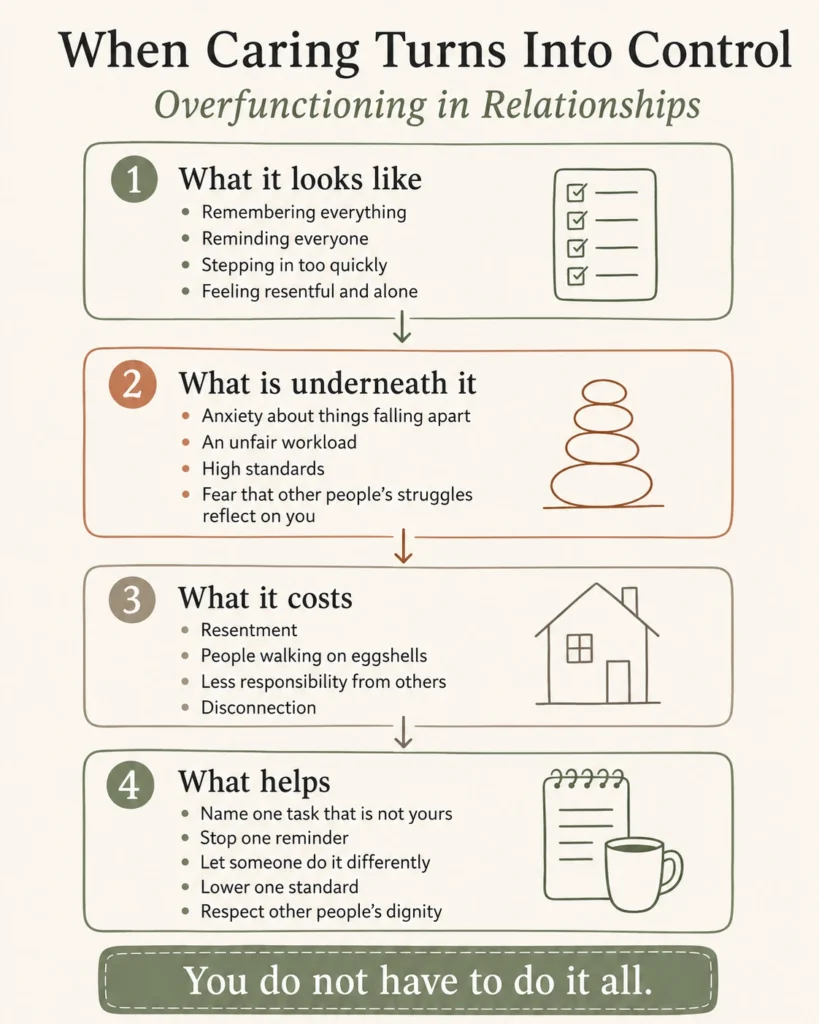
Caring becomes controlling when support turns into responsibility for another person’s tasks, decisions, feelings, or outcomes.
The shift is usually gradual.
You remind someone because you care.
Then you remind them again.
Then you anticipate what they will forget.
Then you make sure it happens.
Then you step in when it does not.
Eventually, you become frustrated that you are the only person who ever thinks about these things.
Meanwhile, the other person may begin to feel watched, corrected, managed, or incapable of satisfying you.
Your intention may still be care.
The impact has changed.
What If the Workload Really Is Unfair?
Sometimes it is.
This matters because not every overwhelmed person needs to be told they should relax, delegate better, or stop being controlling.
There are relationships and families where one person genuinely carries an unreasonable amount of the practical, emotional, and organizational work.
You can be right that the workload is unfair and still be participating in a pattern that keeps you carrying it.
That is where things become complicated.
You may be angry because nobody helps.
At the same time, you may find it almost impossible to leave something undone, tolerate another person’s lower standard, or allow someone else to experience the consequences of forgetting.
Both realities can exist together.
The workload may be unfair.
And your response to that unfairness may be helping preserve the system.
Why Do I Get Resentful When I Do Everything for Everyone?
Resentment often contains useful information.
Sometimes it tells you that you are carrying too much.
Sometimes it tells you that you have taken responsibility for things you do not actually want to carry.
I know I am heading into this territory when I start wanting other people to notice how much I am doing.
Maybe I am huffing.
Maybe I am slamming a cupboard door.
Maybe I am becoming increasingly irritated while waiting for someone to realize I need help.
That can be a useful moment to ask:
Who decided I had to do all of this?
Sometimes the answer is uncomfortable.
You do not have to do all of this.
You think you do.
You may be able to lower the standard right now.

Why Do I Feel Like I Have to Remind Everyone What to Do?
Reminding can become part of an entire relationship system.
If you are always the person noticing what needs to happen, remembering it, reminding someone else, checking whether it happened, and stepping in if it did not, you are still carrying the responsibility.
The other person may technically complete the task.
You are still managing it.
Over time, both people can adapt to that arrangement.
One person remembers.
The other waits to be reminded.
One person monitors.
The other waits to be monitored.
One person becomes increasingly resentful that nobody else takes responsibility.
The system starts reinforcing itself.
Am I Overfunctioning, or Is My Partner Really Underfunctioning?
Sometimes both things are happening.
There may be a genuine imbalance in workload.
There may also be an established pattern in which one person has become so accustomed to managing everything that it is difficult for anyone else to develop meaningful ownership.
Instead of asking, “Who is the problem?” try asking:
What actually belongs to me?
What reasonably belongs to the other person?
What am I doing because nobody else will do it?
What am I doing because I cannot tolerate how, when, or whether someone else will do it?
That distinction helps separate genuine unfairness from anxiety, habit, control, and high standards.
Is Overfunctioning the Same as People Pleasing or Codependency?
Not necessarily.
These patterns can overlap, but overfunctioning is particularly concerned with responsibility.
A person may take too much responsibility because they want approval.
They may fear conflict.
They may need to feel useful.
Being needed may have become part of their identity.
They may also overfunction because they are highly capable, have high standards, dislike uncertainty, or genuinely believe things will fall apart if they stop.
The behaviour may look similar while the reason underneath it is different.
That matters because the way out will also be different.
Can Mental Load Make Someone More Controlling?
Yes.
Mental load is more than completing tasks.
It includes noticing, anticipating, remembering, planning, organizing, and making sure things happen.
When one person carries enough of that responsibility, they can start to feel like they are the only person who understands how everything fits together.
Then delegation becomes difficult.
If you are already thinking six steps ahead, another person’s approach can look inefficient or careless.
You may think:
It would be easier if I did it myself.
And in the short term, it probably would be.
The long-term cost is that everyone else gets fewer opportunities to develop ownership.
Why Is It Hard to Let Someone Do Something Differently From Me?
Because letting another person take responsibility means accepting that they may not perform to your standards.
They may not do it the way you would.
They may not do it when you would.
They may not succeed in the way you hope.
Sometimes they may fail.
That is the part people often leave out when they talk about “letting go.”
Letting go does not guarantee everything will still turn out perfectly.
It means accepting that another person’s life, choices, work, and learning may involve outcomes you would not choose.
Someone else’s success is not yours to manufacture.
Does Overfunctioning Make Other People Less Responsible?
It can.
When we repeatedly take responsibility away from another person, we also take away opportunities for them to practise responsibility.
There is a dignity issue here.
If I constantly rescue you, remind you, manage you, correct you, or protect you from every consequence, I may unintentionally communicate that I do not believe you are capable of managing your own life.
Sometimes stepping back is an expression of respect.
It says:
This belongs to you.
I believe you are capable of carrying it.
What Does Overfunctioning Look Like in Parenting?
Parents are especially vulnerable to this pattern because the desire to protect a child is so strong.
You want them to succeed.
You want them to have friends.
You want them to avoid pain.
You do not want them to be excluded, disappointed, embarrassed, or hurt.
The temptation is to rescue.
But children also need opportunities to solve problems, recover from disappointment, navigate conflict, and experience age-appropriate consequences.
Protecting a child from every discomfort can eventually become another way of taking responsibility for a life that increasingly needs to belong to them.
How Do I Stop Overfunctioning Without Letting Everything Fall Apart?
Start with one specific behaviour.
Do not try to change your entire family system at once.
Notice one place where you are taking responsibility away from somebody else.
Name it.
Then stop doing that particular thing.
Maybe you stop reminding.
Maybe you stop fixing.
Maybe you let someone organize something themselves.
Maybe you allow a child to experience an age-appropriate consequence.
Maybe you let someone complete a task according to their own standard instead of yours.
Then notice what happens inside you.
The discomfort that appears may tell you more than the task itself.
What If I Need to Lower My Standards?
Sometimes lowering a standard is the healthier choice.
Years ago, getting a dog changed something for me.
I had certain standards around keeping the house clean.
Then there was a dog.
There was going to be dirt on the floor.
There was going to be dog hair.
The dog was going to get on the couch.
I had to decide what mattered more.
For me, having children who could feel happy and relaxed in their home mattered more than maintaining the standard I previously had for the house.
That was not really a decision about cleanliness.
It was a decision about values. It was hard.
Sometimes letting go is not about caring less.
It is about deciding what you care about more.
When you are struggling to let something go, ask:
What standard am I trying to protect?
What value does that standard serve?
Is protecting this standard costing me something I value more?
What Happens When the Responsible Person Stops Managing Everything?
At first, things may become less efficient.
Someone may forget something.
The house may not look the same.
A task may be done differently.
A child may experience disappointment.
Another adult may have to solve a problem they previously relied on you to solve.
That discomfort does not necessarily mean the change is failing.
Something else may begin to happen.
Other people have room to become more responsible.
They develop competence rather than waiting to be rescued.
They learn how to solve problems.
They make decisions without constantly worrying about disappointing the person who has been managing everything.
Relationships may improve too.
People may stop feeling like they are walking on eggshells.
They can relax.
They may stop feeling like they are constantly falling short of your expectations.
And the responsible person gets to discover that not everything belongs to them.

Caring Without Owning the Outcome
The goal is not to become detached.
It is not to stop helping.
It is not to ignore genuine unfairness.
The goal is to become clearer about the boundary between caring and ownership.
You can care deeply about another person’s life without taking responsibility for how that life unfolds.
You can support someone without managing them.
You can love someone and allow them to struggle.
You can want good things for your employees and your children without making their success proof that you have done well.
You can ask for a fairer division of labour without becoming another adult’s supervisor.
You can be highly capable without doing everything yourself.
Sometimes the most respectful thing you can do is allow another person to carry what belongs to them.
And sometimes the most important thing you can say to yourself is:
You do not have to do all of this.

What The Consult is For
Your free 20 minute consult is to clarify three things:
1. What kind of depletion this is
2. What kind of help you need
3. Whether I am the right fit for your situation
There is no expectation to continue. If another type of support fits better, I will say so.
You can take time to think afterward. No decision needed on the call.