Fear of Losing Your Job: When Work Stress Starts Affecting Your Mental Health
You tell yourself it’s temporary.
You just need to get through this stretch.
You need more time.
A vacation.
A new job.
A break.
So you keep pushing.
Meanwhile, something starts changing internally.
You wake up with dread before work.
Mental health days are starting to creep in more often.
Your chest feels tight before meetings.
You struggle to relax at night because your brain keeps scanning for what could go wrong.
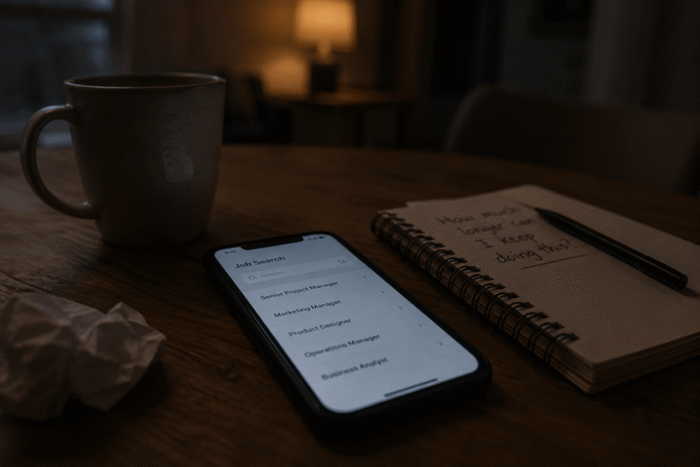
You start bulk applying for jobs you don’t even want because getting out starts to feel urgent.
At some point, this stops feeling like ordinary work stress.
Your nervous system starts reacting to work like a threat instead of a responsibility.

Why does fear of losing your job cause anxiety and burnout?
Fear of losing your job can trigger anxiety, burnout, and physical stress symptoms because it creates ongoing uncertainty and a lack of control. When your income, stability, or identity feel at risk, your nervous system may shift into a constant state of alert.
This can lead to:
– persistent worry about work or the future
– difficulty relaxing or sleeping
– overworking or compulsively job searching
– panic symptoms such as chest tightness or shortness of breath
– emotional exhaustion, low mood, or withdrawal from others
For many professionals, this is a survival response to prolonged pressure and uncertainty.
Why can’t I stop working even when I’m exhausted?
When you feel uncertain about your job or financial stability, working harder can temporarily reduce anxiety. It creates a sense of control and progress, even if the situation has not actually changed.
Over time, your brain learns: “Keep going, or something could go wrong.”
This can make it difficult to stop, even when you are physically and emotionally depleted.
Is this anxiety or burnout?
It is often both.
Anxiety shows up as:
– racing thoughts
– constant problem-solving
– fear about what could happen
Burnout develops when that state continues over time, leading to:
– exhaustion
– cynicism
– loss of personal effectiveness
– feeling trapped or overwhelmed
When should I get support?
You may need support if:
– work stress is affecting your sleep or physical health
– you feel panic, dread, or constant pressure
– you are struggling to think clearly or make decisions
– you feel stuck, trapped, or unable to recover
These are signs your system is overloaded, not that you are weak.
Support can help you understand what is driving the stress, reduce the pressure on your system, and shift your beliefs to help you find a more sustainable way forward.
Why Job Uncertainty Keeps People Stuck in Survival Mode
Work becomes psychologically destabilizing when there is ongoing uncertainty and very little sense of control.
You may feel trapped between:
- needing income
- fearing burnout
- pressure from loved ones
- lack of options
- uncertainty about whether another opportunity will appear in time
That uncertainty keeps the nervous system activated.
Your brain keeps trying to solve the problem:
- plan more
- prepare more
- apply more
- think more
- work harder
- stay ahead
The system keeps saying: “You are not safe yet.”
For many professionals, the fear is not only about losing a paycheck.
It is also about:
- stability
- identity
- competence
- security
- protecting the people who depend on you
That creates enormous internal pressure.
What People Start Doing When Panic Takes Over
Most people do not immediately recognize this as burnout or nervous system overload.
At first, it looks productive.
You may:
- endlessly scroll job postings
- bulk apply to jobs without much thought
- mentally rehearse worst-case scenarios
- obsessively check emails or messages
- isolate from people because interaction feels draining
- fantasize about escape while feeling unable to act clearly
This might feel like procrastination about the things that need to get done – and no, they are not signs of laziness.
They are survival responses.
Your system is trying to reduce uncertainty as quickly as possible.
The problem is that survival mode narrows your thinking.
You stop asking:
“What do I actually want?”
And start asking:
“How do I get out fast enough?”
Why High-Functioning People Miss the Warning Signs
Many capable people override distress for a long time.
They are used to being:
- competent
- reliable
- productive
- successful under pressure
So when symptoms start appearing, they often assume:
“I should be able to handle this.”
That creates shame.
People start believing:
- they are weak
- they are failing
- they should have had a backup plan
- they are not strong enough
- they are becoming negative or difficult to be around
At the same time, many are terrified that others will think they are exaggerating or “making it up.”
So they continue performing while quietly deteriorating internally.
Many high-functioning people do not recognize burnout until their body starts forcing the issue.
Not sure if this is burnout or something else?
Take the 2-minute Professional Strain Check-In:
When Work Stress Starts Affecting the Body
Over time, the pressure stops staying mental.
The body starts carrying it too.
This can show up as:
- chest tightness
- shortness of breath
- sleep interruption
- panic attacks
- exhaustion
- increased illness
- hair loss
- dread before work
- difficulty recovering emotionally after the workday ends
These symptoms should always be medically evaluated appropriately.
But many people discover that prolonged stress, uncertainty, and nervous system activation are playing a major role in what their body is experiencing.
At some point, the body stops quietly absorbing the pressure.
It starts demanding attention.

What’s Actually Happening Underneath the Panic
Sometimes people think they are “breaking down.”
What is often happening instead is that their nervous system no longer feels safe.
When uncertainty becomes chronic, the brain starts treating work as an ongoing threat.
Your system stays activated because it believes:
- something bad could happen
- stability could disappear
- criticism could appear suddenly
- failure could carry serious consequences
- stopping could become dangerous
For some people, older experiences involving instability, criticism, unpredictability, or emotional unsafety can intensify these reactions even further.
The result is a system that struggles to power down.
Even rest starts feeling difficult.
Why Pushing Harder Stops Working
For many professionals, the strategies that once created success eventually stop working.
Pushing harder may have worked earlier in life or career stages.
But under chronic stress and uncertainty, constant performance becomes unsustainable.
People often notice themselves becoming:
- cynical
- emotionally withdrawn
- exhausted
- reactive
- hopeless
- disconnected from themselves
- protective of their energy and time
Work starts feeling less meaningful and more threatening.
The goal shifts from growth to survival.
That shift is emotionally painful for people who once felt capable and steady.
What People Actually Need During This Stage
Most people do not need more pressure.
They do not need to be told to simply “stay positive.”
And many do not need another productivity strategy.
They need clarity.
They need help understanding:
- what is actually causing the distress
- what belongs to them and what does not
- what their nervous system is reacting to
- whether the current environment is sustainable
- what kind of support or strategy is actually appropriate
They also need permission to stop performing at the same level that chronic stress once forced them to maintain.
Your feelings are real.
Your body is affected.
This is not weakness, and it’s good to get support.
When Support Starts to Help
Support is not about becoming “less capable.”
It is about creating enough steadiness and clarity that your system no longer has to stay in survival mode all the time.
When people start feeling safer internally, they often notice:
- clearer thinking
- reduced panic
- improved sleep
- less emotional reactivity
- more realistic decision-making
- greater ability to evaluate options calmly instead of desperately
That does not happen overnight.
But it does happen.
If work stress, uncertainty, or burnout are starting to affect your mental health, support is available. Contact me and book a free consultation to get started.
I provide online therapy across Ontario for professionals dealing with burnout, work stress, anxiety, and nervous system overload.