Who Am I Outside of My Job? When Burnout Turns Into an Identity Crisis
Identity crisis from work happens when your sense of self becomes tied to your role. When your job is how you measure your worth, time away from it can feel disorienting, and even small setbacks can feel personal.
Many high achievers describe this as losing themselves in their career or realizing they don’t know who they are outside of their job.
Has burnout changed more than your energy?
Take this 3-minute Identity Burnout Check-In to explore whether chronic stress may be affecting your sense of self, not just your energy.
What does an identity crisis from work feel like?
An identity crisis from work often feels like:
– feeling stuck even while performing well
– questioning your direction or purpose
– not knowing what you enjoy outside of work
– feeling unsettled when you stop being productive
– thinking “something has to change,” but not knowing what
Something Has to Change (But You Don’t Know What Yet)
This is usually how it starts.
Not with collapse.
Not with burnout you can’t ignore.
With a quieter realization:
- This is unsustainable
- I feel stuck
- I want something different for my life
- I can’t keep doing this the same way
From the outside, nothing looks wrong.
But internally, something has shifted.
You’re no longer convinced this version of your life fits.
Losing Yourself in Your Career Happens Gradually
You don’t decide to lose yourself in your career.
It happens slowly:
- you take on more responsibility
- you become known as reliable
- you get used to being the one who handles things
Over time, the role becomes central.
Other parts of you get postponed:
- interests
- preferences
- curiosity
- rest that actually restores
Eventually, you stop asking what you want.
Because there hasn’t been space to want anything.
You don’t need to hit burnout to have an identity crisis. You only need to lose touch with who you are outside of what you do.
“Who Am I Outside of My Job?” Is a Real Question
This is the moment people don’t expect.
You step away from work, and instead of relief, there’s discomfort.
You might notice:
- restlessness on vacation
- difficulty deciding how to spend your time
- a sense that something is missing
Because work has been doing more than providing income.
It has been organizing your identity.
Without it, there’s no clear internal reference point.

High Achiever Identity Crisis Doesn’t Look Like Failure
This is where people get confused.
You’re still:
- competent
- trusted
- performing well
But internally:
- you feel flat
- you question your direction
- you’re less certain of yourself
This is a high achiever identity crisis.
Not because you’ve failed.
Because your identity has been built around performance for too long.
Why Burnout Turns Into an Identity Crisis
Burnout doesn’t only drain energy.
It removes your capacity to engage with anything outside your role.
When energy is low, your system shifts into efficiency and protection:
- do what’s required
- avoid what’s unnecessary
- conserve what’s left
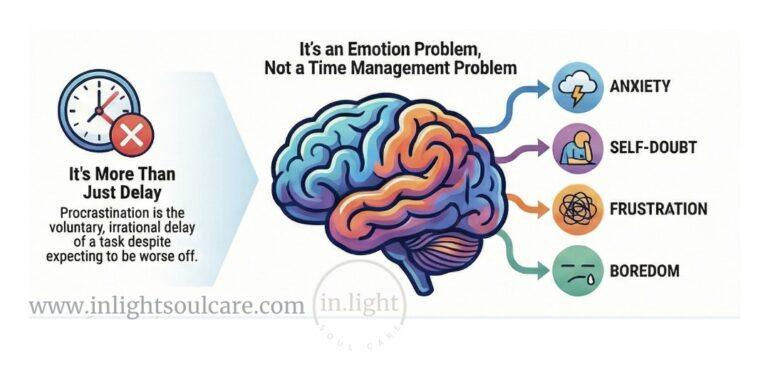
That’s why life starts to narrow. For some people, this shows up as difficulty starting tasks, even when they know what needs to be done:
- more scrolling
- more avoidance
- less reflection
- less engagement with yourself
Over time, this becomes a deeper pattern of burnout and loss of identity.
When Work Becomes Your Source of Self-Worth
At some point, work stops being something you do.
It becomes how you know you’re okay.
So when something goes wrong:
- feedback feels personal
- mistakes feel heavier
- pressure increases
- overthinking at 3am
You don’t think:
“That didn’t go well.”
You think:
“What does this say about me?”
This is where the drive to keep proving yourself comes from.
Not ambition.
Stability.
This pattern is consistent with developmental models like those of Erik Erikson, where identity becomes tied to competence and recognition when internal worth isn’t fully secure.
In some cases, this isn’t only burnout. It’s a deeper misalignment between your role and your values.
Signs You’re Experiencing an Identity Crisis From Work
- You don’t know what you enjoy outside of work
- You feel unsettled when you’re not being productive
- You rely on work to feel confident or grounded
- You feel like you’ve lost something, but can’t name it
- You keep thinking: something has to change
“I’m Ready to Reinvent Myself” (But Don’t Know How)
This is the turning point.
You might find yourself thinking:
- I’m ready to reinvent myself
- I want something different for my life
- I just don’t know what that is yet
The mistake here is thinking you need a complete overhaul.
Most of the time, this isn’t about becoming someone new.
It’s about separating who you are from what you’ve been carrying.
I’m Erika Mills, a Registered Psychotherapist for professionals and leaders. I help high-achievers who are carrying too much for too long. If you’re feeling the strain of burnout or identity fatigue, we can work together to lower the pressure, redefine your relationship with performance, and reclaim your inner authority.

How to Start Rebuilding a Sense of Self
Not by quitting your job.
Not by making a drastic change.
By rebuilding internal clarity.
That looks like:
- identifying what actually matters to you (not what you’re good at)
- noticing where your worth is being measured
- separating your role from your identity
- creating space to experience yourself outside of performance
This is slower work.

But it’s what makes change sustainable.
Identity Crisis and Burnout in Professionals Across Ontario
For many professionals across Ontario, this shows up in roles where responsibility stays high and performance remains strong, but the internal cost keeps building.
You’re still capable.
But something doesn’t feel like it fits anymore.
The Question That Signals It’s Time
Most people don’t say this out loud at first.
But it’s usually there:
“If I’m not this version of me, then who am I?”
That’s not a breakdown.
That’s the beginning of something more honest.
If you’re in Ontario, this pattern is common in high-responsibility roles where performance stays high, but the internal cost keeps building.
If you’re feeling stuck, questioning your direction, or noticing that work has started to define more of you than it should, it’s worth understanding what kind of strain you’re actually dealing with.
Start with the check-in. Then decide what kind of support fits.
What The Consult is For
Your free 20 minute consult is to clarify three things:
1. What kind of depletion this is
2. What kind of help you need
3. Whether I am the right fit for your situation
There is no expectation to continue. If another type of support fits better, I will say so.
You can take time to think afterward. No decision needed on the call.