Identity & Burnout Therapy for Professionals in Ontario
Work Stress, Burnout & Constant Pressure That Won’t Switch Off
You’re still doing your job, but it’s taking more out of you than it should. As a Registered Psychotherapist, I help Ontario professionals recover from chronic strain, identity loss, and the work stress that follows them home.
Erika Mills, RP, MTS, CSHP — Registered Psychotherapist (CRPO #15213)
Providing confidential virtual therapy across Ontario. Covered by most extended health benefit plans.


If work is starting to affect more than your work, it’s time to get support.
You’re still functioning, but something feels off. People usually start looking for a therapist for burnout when carrying the pressure alone is no longer working.
Work stress is following you home, affecting your focus, or changing how you feel about yourself.
If work has reached the point where you’ve needed to step away, learn how therapy can support recovery during stress leave.


Burnout and Identity
When stress starts to affect your confidence, clarity, and sense of self.

Why You Procrastinate
You’re capable, but everything feels harder to start. This is a common burnout pattern.
– Burnout that includes anxiety, Trauma and loss of Identity –
Burnout is Often Assumed To Come From Workload
For many people, it comes from how much you are carrying internally while you work.
It can look like:
– making decisions you cannot fully stand behind, then replaying them afterward
– carrying responsibility for people or outcomes you cannot fully control
– staying composed while absorbing pressure all day
– monitoring how things are going, even when you are technically “off”
– losing clarity about what you actually think or want beneath your role
Over time, the problem is not energy.
It’s the strain of holding too much, for too long, without a place to put it down.
That’s why rest doesn’t fix it.
This is usually the point where people start to feel stuck.
While Burnout Syndrome is a work-related issue, many family caregivers experience
exhaustion, grief, and a gradual loss of identity too.
Learn more about caregiver burnout and identity loss.
You don’t need to figure it out on your own.
Start with a 20-minute consult and we’ll look at what’s actually going on.
What Kind of Burnout is This?
Many people I work with are still competent at their jobs. The problem is not performance. Over time your role has started to override your sense of self. You keep functioning but feel less like yourself inside the work. I refer to this as identity-eroding burnout.
You might notice:
– dread before the day starts, without a clear reason why
– procrastination despite knowing exactly what to do
– feeling responsible for how things go, even when it’s not fully yours
– losing a sense of who you are outside of your role
– replaying decisions or conversations long after they’re over
This doesn’t look like burnout from the outside. It builds quietly on the inside.
Burnout Therapy for Caregivers and High-Responsibility Roles:
This is not general stress counselling.
Many professionals already understand their thoughts and emotions. The difficulty is continuing to function while carrying decisions, expectations, and others.
In our work we focus on:
• separating high responsibility from over-responsibility
• reducing constant internal pressure
• rebuilding boundaries that still allow you to care
• deciding whether to stay in your role
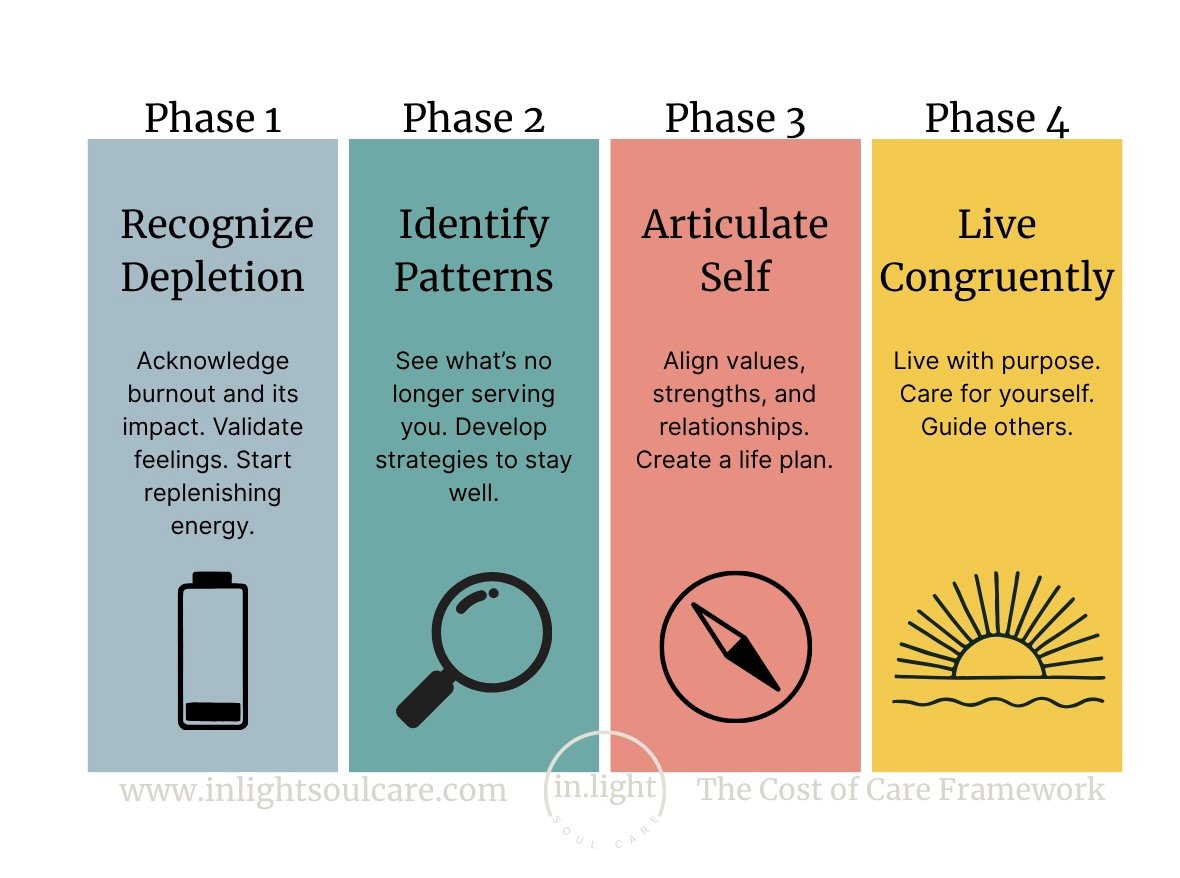
I use a four-phase burnout treatment approach that helps you stabilize, clarify, decide, and rebuild sustainable work. I use this framework with therapy clients and education clients.
Stabilize – reduce immediate pressure and mental overload
Clarify – understand what you are carrying and what is actually yours
Decide – make grounded choices about your role and responsibilities
Rebuild – create a way of working that is sustainable long-term
If you’re looking for online burnout therapy in Ontario, I provide virtual psychotherapy for professionals dealing with work stress, burnout, moral injury, and the pressure of high-responsibility roles.
From Functioning To Sustainable
Many professionals and burned-out caregivers who seek this work are still showing up.
What changes first is internal:
– less dread before the workday starts
– clearer thinking and faster decisions
– fewer loops of replaying conversations or choices
– the ability to care about your work without staying mentally responsible for it all night
Burnout recovery here is understanding what is yours to carry and what is not, then rebuilding a workable relationship with your role.
Some people experience this less as stress and more as a responsibility they cannot set down.

Why capable people still burn out
Burnout often develops in people who stay steady under pressure, solve problems quickly, and take responsibility seriously. The cost accumulates quietly: mental carryover after hours, reduced patience, and difficulty switching off even when nothing urgent is happening.

What actually wears you down
The problem is rarely workload alone.
It is prolonged decision pressure, emotional containment, and holding outcomes you cannot fully control. Over time the mind stays in a constant monitoring state instead of a resting state. That is why rest does not restore you the way it used to.

What recovery changes
We focus on adjusting how responsibility is carried so that work remains demanding but not consuming.
Therapy can support clearer thinking, less after-hours rumination, and a more sustainable relationship with responsibility.
What The Consult is For
Your free 20 minute consult is to clarify three things:
1. What kind of depletion this is
2. What kind of help you need
3. Whether I am the right fit for your situation
There is no expectation to continue. If another type of support fits better, I will say so.
You can take time to think afterward. No decision needed on the call.
Burnout Starts Long Before It Becomes A Crisis.

About Erika Mills
I work with professionals whose roles require steady judgment, emotional containment, and responsibility for others.
My background includes psychotherapy, ethics, and spiritual health education. Because of that, clients usually do not need to explain the culture or weight of their work before we begin.
This is practical therapy. We clarify what you are carrying, what is yours to hold, and how to keep working without losing yourself.
Still unsure?
If you are wondering whether your situation “counts” as burnout, that is usually the right time to ask.
The consult is simply a conversation to understand what is happening and whether this kind of work would help.
You can decide afterward. No commitment required.
Blogs
Why You Don’t Feel Like Yourself Anymore: A Guide To Identity Burnout
You can be capable, responsible, and still feel like something essential is missing. This is burnout that comes from losing connection to who you are and what matters. Naming that loss is often the beginning of healing.
The Hidden Burnout of High Achievers: When Being the Reliable One Becomes Exhausting
High achievers often arrive in therapy describing their accomplishments and competence. Yet many quietly carry burnout, work stress, and responsibility that has become overwhelming. This article explores the hidden burnout of reliable professionals and why having a confidential place to think out loud can help high-responsibility leaders regain clarity, alignment, and energy.
Why You Procrastinate When You’re Burnt Out (Not Lazy)
Procrastination is not always a motivation problem. In burnout, it is often a nervous system signal.
When your system has been overextended for too long, starting tasks can feel strangely impossible, even when the work matters to you. This is not laziness and it is not a character flaw. It is what happens when effort, responsibility, and pressure have outpaced your capacity to recover.
In burnout, procrastination often functions as a form of self-protection. Your mind and body slow you down because pushing forward no longer feels safe. Understanding this shift is essential, because trying to fix burnout-related procrastination with productivity tools alone usually makes things worse.
This article explores why procrastination shows up during burnout, how to tell the difference between avoidance and exhaustion, and what recovery-focused approaches actually help people regain momentum without forcing themselves past the breaking point.












Psychotherapy for leaders experiencing sustained decision fatigue and responsibility strain,
You can read more about executive burnout therapy here.
Leaders sometimes face moral tension in their roles that creates isolation.
I explore this experience further in the loneliness of leadership.