
Online Therapy for Work Stress and Anxiety in Ontario
When Work Stress Turns Into Anxiety
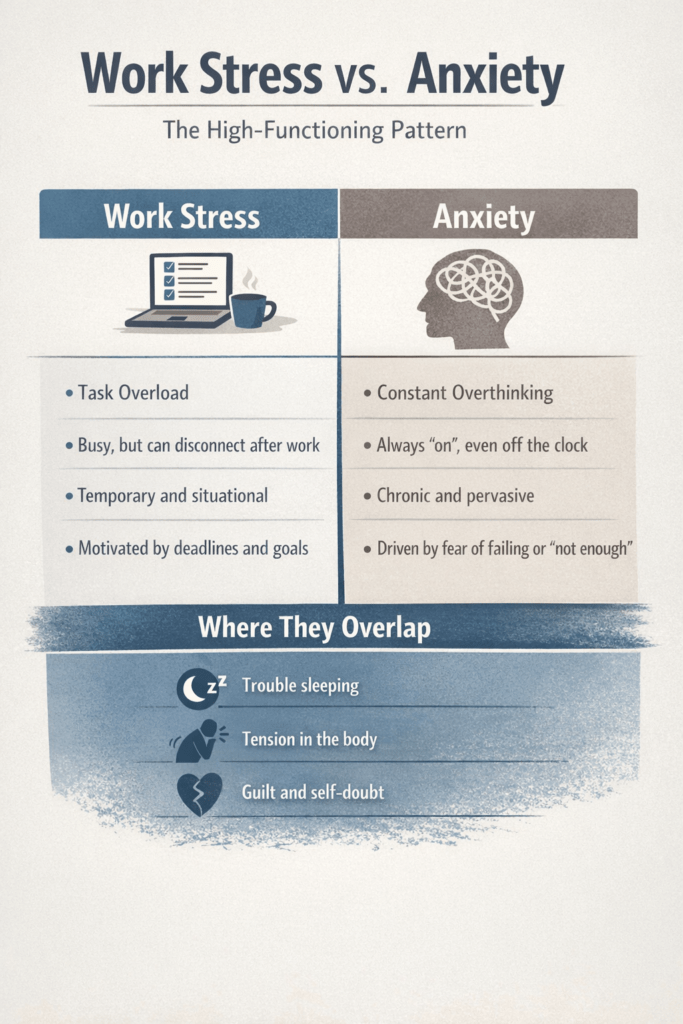
Work stress and anxiety often show up together, especially when you can’t fully switch off after work.
Sometimes this becomes most noticeable as Sunday night anxiety before work, when your mind starts rehearsing Monday before the weekend has ended.
You may still be performing well, but your mind keeps running, replaying decisions, or staying on alert long after the workday ends. Over time, this can lead to burnout, emotional exhaustion, and a growing sense that something isn’t right.
Therapy for work stress and anxiety focuses on understanding what is driving the pressure, how it is affecting your nervous system, and how to respond in a way that is sustainable. If you want to learn more about my framework for burnout treatment, click here.
Why Work Stress Doesn’t Feel Like Anxiety at First
As an Ontario psychotherapist specializing in work stress and professional strain, there’s a pattern I see often.
People rarely show up saying, “I’m anxious.”
They say:
– “I’m here because of work stress”
– “I’m exhausted”
– “I don’t know how much longer I can keep this up”
– “My body feels like it’s starting to break down”
And yet, they’re still doing everything.
Still showing up to meetings. Still being the person everyone relies on.
But underneath that, the anxiety is building. It shows up in the body first, as tension, pressure, and the inability to fully switch off.
When you’re capable, responsible, and used to carrying a lot, work stress and anxiety can become tied to your identity. It stops feeling like stress and starts to feel like who you are.
This is where burnout and identity strain begin to take hold.
Has Work Stress Started Changing Who You Are?
When pressure continues for too long, it can affect more than your energy or ability to switch off. Take this 3-minute check-in to explore whether chronic stress may also be affecting your sense of self.
The people I work with are often nurses, teachers, and leaders who can see that something isn’t sustainable, even if everything still looks “fine” from the outside.
Visit my homepage to learn more about online therapy for work stress and anxiety in Ontario.

If this feels familiar, it often overlaps with high-responsibility burnout, where the pressure isn’t just the work, it’s how much you feel responsible for holding everything together.
Why Work Anxiety Feels Like a Personal Failure
This is what makes work stress and anxiety so hard to recognize. The guilt.
Many people carry an underlying belief:
– If I were better at my job, this wouldn’t feel so overwhelming
– If I admit I’m struggling, people will think I’m weak
– If I slow down, everything will fall apart
So instead of asking for help, they work harder.
Instead of taking a break, they keep going.
This hits hardest when your identity is built around being reliable.
The same traits that made you successful, responsible, capable, become the reason you stay stuck under constant pressure.
What Work Anxiety Actually Looks Like
Anxiety doesn’t always look like a panic attack.
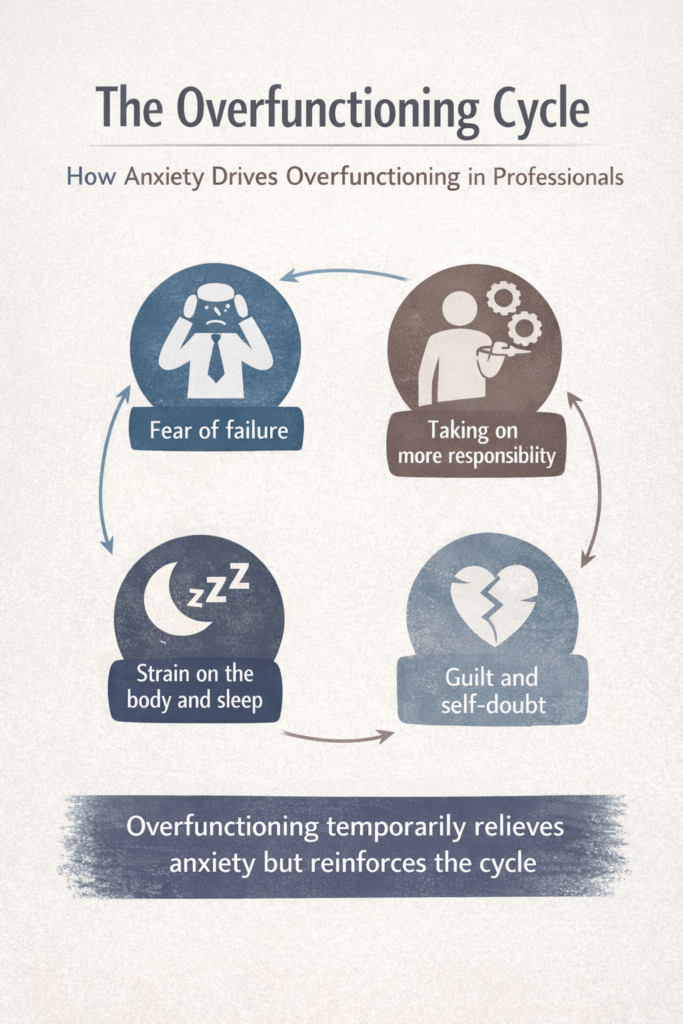
When it’s tied to work stress, it often looks like overfunctioning.
You take on more than anyone should reasonably carry.
You struggle to delegate, even when you technically could, because it feels like too much is at stake.
You stay mentally at work long after the day ends.
You’re not only managing tasks, you’re absorbing other people’s emotions and problems.
And you’re constantly scanning for what might go wrong next.
Underneath all of this is usually fear.
Fear of failing.
Fear of disappointing people.
Fear of being exposed as less capable than others believe.
And your body starts to show it.
Sleep becomes lighter and more fragmented.
Your shoulders stay tense.
You get sick more easily, or it takes longer to recover.
Focus drops.
You might notice headaches, digestive issues, or a level of exhaustion that doesn’t lift with rest.
This is what happens when your nervous system stays on high alert for too long.
When close supervision or repeated correction is part of the pressure, it can contribute to workplace hypervigilance. Read more about how micromanagement can keep your nervous system on high alert at work.
For many leaders, this is where burnout starts: almost invisibly.
Why Pushing Through Work Stress Stops Working
Early on, pushing through probably worked. Work hard, get results. Take on more responsibility, get recognized. Grit equals success.
Over time, chronic stress changes how your nervous system responds.
Your body loses its ability to settle.
Stress hormones stay elevated.
Rest stops feeling restorative.
And then the shame creeps in: Why can’t I handle this anymore? What happened to me?
Nothing happened to you. Your system is doing exactly what systems do when they’re under constant pressure without enough recovery. You’re responding normally to an unsustainable situation.
Then the doubt creeps in: Why can’t I handle this anymore? What changed?
Your system is responding to sustained pressure without enough recovery. That response is a signal that the current pattern has become unsustainable.
What you need is a completely different relationship with your stress.
Treatment for Work Stress and Anxiety
Treatment for work stress and anxiety is not about pushing through or becoming more productive.
It focuses on:
– Understanding how chronic stress is affecting your body
– Identifying patterns of overfunctioning and internal pressure
– Learning how to respond to stress without escalating it
– Building capacity for rest, clarity, and decision-making
When stress has been building for a long time, it often overlaps with burnout. You can read more about how this is treated here: burnout treatment
This often shows up as not being able to switch off after work, even when nothing urgent is happening.
What actually helps (without compromising who you are)
Therapy for work stress and anxiety focuses on helping you respond differently to pressure, rather than continuing to absorb it.
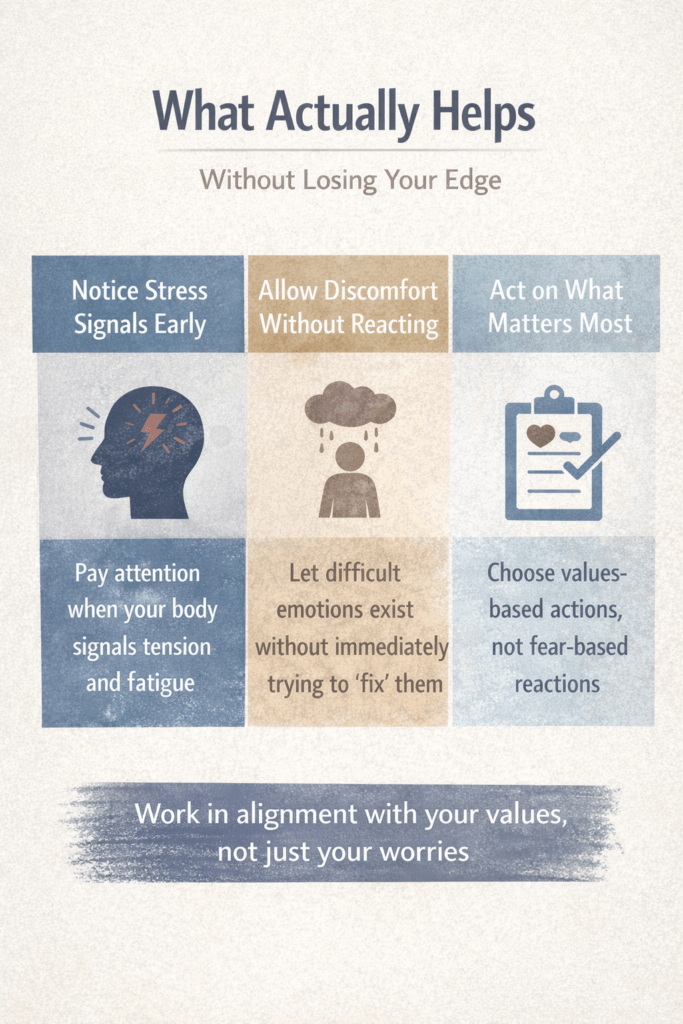
The shift I see make the biggest difference in therapy isn’t about eliminating stress or discomfort, that’s not realistic.
It’s about learning to:
- Notice when your body’s sending you signals, earlier than you used to
- Let uncomfortable feelings exist without immediately trying to fix or escape them
- Make choices based on what matters to you, not just what you’re afraid of
Sometimes that means setting a boundary even though the guilt is loud. Delegating something even though letting go feels terrible. Resting without needing to earn it or justify it to yourself.
This is where psychological flexibility comes in. When you can make room for stress, doubt, or anxiety without letting them call all the shots, you get your agency back. Read more about ACT as an intervention for work stress.
You don’t have to become a different person or abandon your work ethic. You learn how to work in a way that doesn’t slowly destroy you.
When to Consider Therapy for Work Stress
If your stress is no longer turning off, your body is staying activated, or your work is starting to affect your health or relationships, it may be time to get support.
You do not need to wait until you are fully burned out.
If you are already away from work or considering a leave, learn more about online therapy during stress leave in Ontario.

Why Work With Me?
Certified Expertise: I am a Registered Psychotherapist (CRPO) and a Certified Supervisor-Educator (CASC/ACSS), with a career-long focus on supporting helping professionals and leaders.
Accessible Support: I provide secure, private, online therapy sessions tailored to professionals across Ontario.
If this sounds familiar
If you’re reading this and thinking “oh… that’s me,” therapy can help you:
- Figure out how anxiety is driving you underneath what looks like normal work stress
- Separate your sense of worth from your ability to handle everything perfectly
- Build actual boundaries without drowning in guilt afterward
- Reconnect with who you are when you’re not performing
A lot of professionals wait until they’re completely burned out before they reach out. You don’t have to wait that long.
If you’re in a leadership role and this is resonating, I write more about this in my work with executive burnout, specifically about finding ways to lead that don’t cost you your health or your sense of self.
Beginning psychotherapy can create space to understand what is driving the stress and develop more sustainable ways of responding.
Explore more work stress and burnout resources.
What The Consult is For
Your free 20 minute consult is to clarify three things:
1. What kind of depletion this is
2. What kind of help you need
3. Whether I am the right fit for your situation
There is no expectation to continue. If another type of support fits better, I will say so.
You can take time to think afterward. No decision needed on the call.